In the age of information explosion, researchers, scholars, and professionals face a major challenge: staying updated with the vast amount of literature published daily. Browsing through every new journal, article, or report is virtually impossible.
To address this challenge, libraries and documentation centers provide personalized and timely information services known as Current Awareness Services (CAS) and Selective Dissemination of Information (SDI). Both services aim to keep users updated, but they differ significantly in their approach, customization, and scope.
What is Current Awareness Service (CAS)?
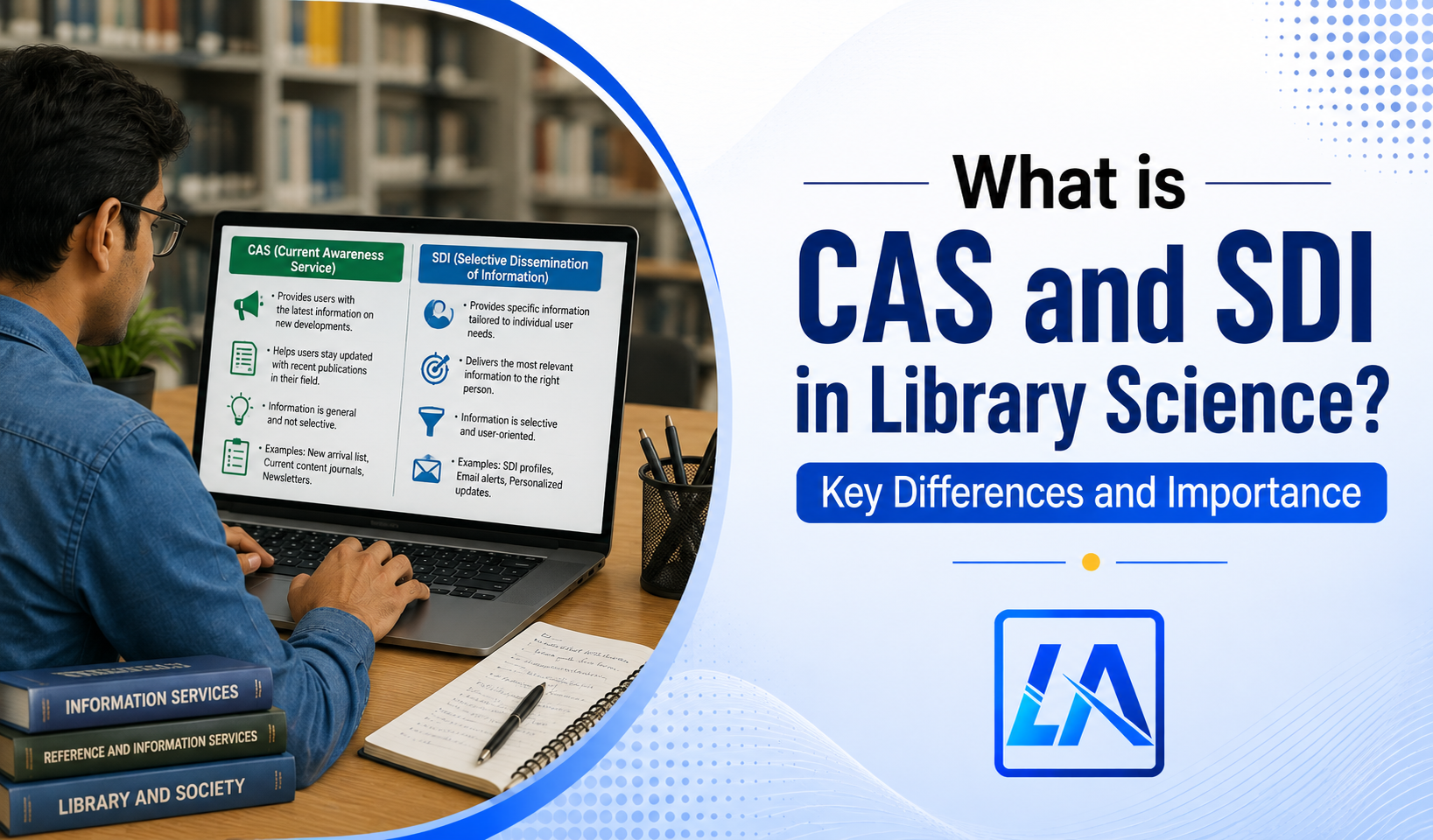
CAS (Current Awareness Service) is a broad, non-personalized information service designed to inform library users about the latest literature added to the library’s collection or published in a specific field.
Key Characteristics of CAS
- General Audience: It targets a group of users or an entire department rather than a single individual.
- Non-Personalized: Every subscriber or reader receives the exact same set of information.
- Timeliness: Provided regularly (weekly, bi-weekly, or monthly) so users receive fresh updates promptly.
Common Examples of CAS
- Current Contents Lists: Circulation of table of contents of newly arrived journals.
- New Arrival Bulletins: Lists of newly acquired books and reports in the library.
- Indexing and Abstracting Bulletins: Summaries of recent scholarly literature in a discipline.
- Notification of Conferences/Seminars: Announcements of upcoming academic events.
What is Selective Dissemination of Information (SDI)?
Conceptually introduced by Hans Peter Luhn in 1958 at IBM, SDI (Selective Dissemination of Information) is a highly specialized and personalized subset of CAS. It uses automated computer processes to match newly published literature directly with an individual user’s specific research interests.
How SDI Works (Step-by-Step Process)
- User Profile Creation: The user’s exact research interests are defined using precise keywords, subject codes, and Boolean logic.
- Document Profile Creation: As new materials arrive, cataloguers index them using keywords and subject descriptors.
- Matching Mechanism: An automated or computer-assisted process compares the Document Profile against the User Profile.
- Notification: When a match occurs, the user receives an alert (via email or library portal) containing citations or abstracts of relevant documents.
- Feedback Loop: The user reviews the notifications and provides feedback (e.g., “Relevant” or “Not Relevant”). The system then updates the User Profile to refine future matches.
Key Differences: CAS vs. SDI
| Feature | Current Awareness Service (CAS) | Selective Dissemination of Information (SDI) |
| Originator / Pioneer | General library evolution | Hans Peter Luhn (1958) |
| Scope / Orientation | Group or general audience | Individual user focus |
| Customization | Universal (same list for everyone) | Highly personalized (tailored to user profile) |
| Feedback Mechanism | No feedback loop required | Essential feedback loop to adjust profile |
| Operation Type | Mostly manual or broadcast-style | Automated keyword-matching process |
| Selectivity | Low (broad coverage) | Very high (filters out non-relevant data) |
Importance in Modern Information Systems
Both CAS and SDI save researchers critical time by preventing information overload. In modern digital libraries and Web-OPACs, SDI features are integrated as email alerts, RSS feeds, and saved search notifications in academic databases like Scopus, Web of Science, and PubMed.
Conclusion
While CAS acts as a general news digest for library resources, SDI functions as a personalized research assistant. Together, CAS and SDI form the foundation of proactive information services, ensuring that researchers stay at the cutting edge of their fields without getting overwhelmed by irrelevant data.
References & Citations
- Guha, B. (1983). Documentation and information: Services, systems and techniques (2nd ed.). World Press.
- Luhn, H. P. (1958). A business intelligence system. IBM Journal of Research and Development, 2(4), 314–319.
[https://doi.org/10.1147/rd.24.0314](https://doi.org/10.1147/rd.24.0314) - Ranganathan, S. R. (1965). Documentation and its facets. Asia Publishing House.
- Rowley, J. E., & Turner, C. M. D. (1978). The dissemination of information. Linnet Books.