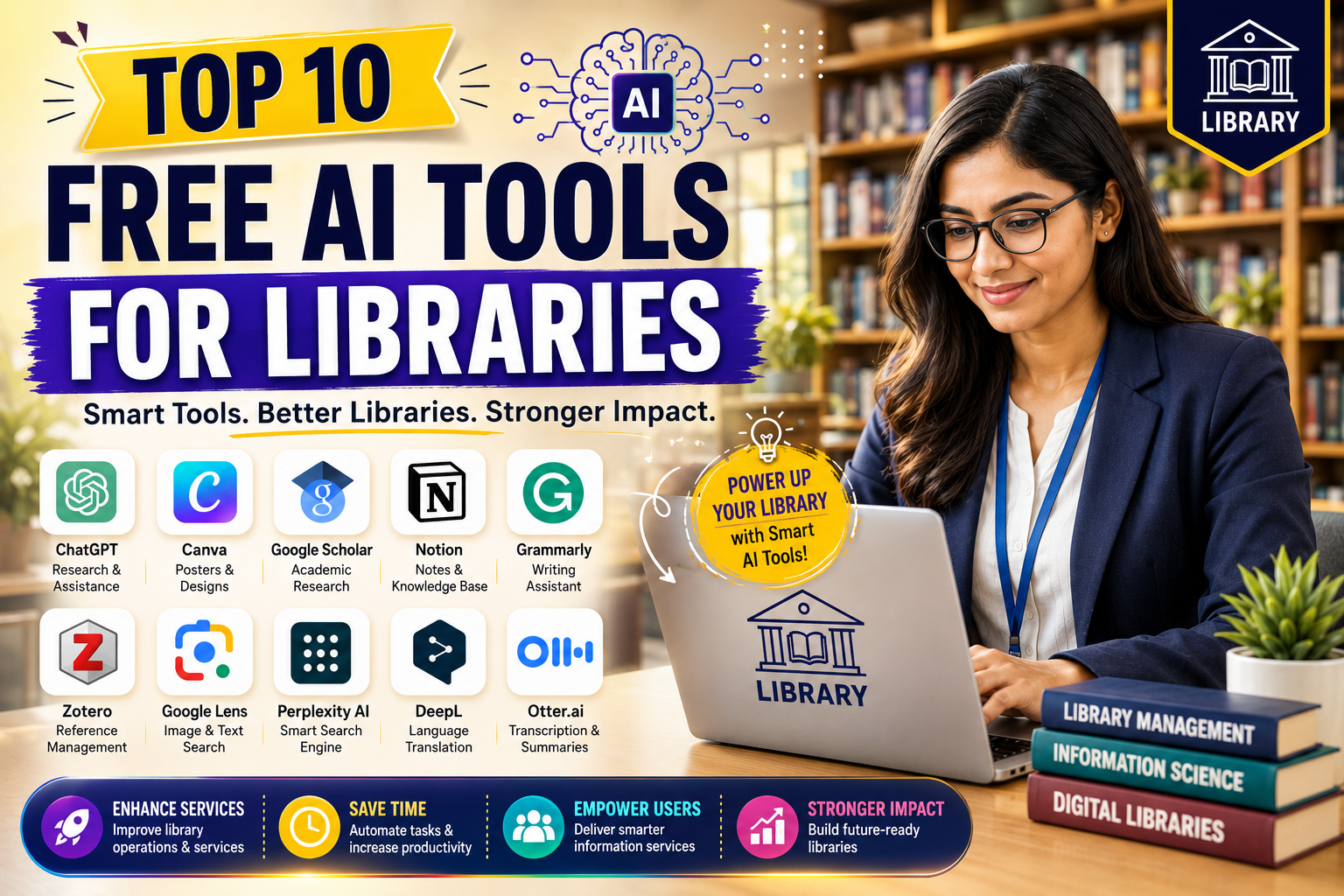
Artificial Intelligence (AI) is transforming libraries worldwide. AI tools are helping librarians save time, improve library services, support research, create content, analyze documents, and assist library users.
Whether you are a Librarian, Library Science Student, Researcher, Teacher, or Information Professional, learning AI tools can significantly improve productivity and research skills.
In this article, we explore the Top 10 Free AI Tools for Libraries, along with their developers and original launch years.
Top 10 Free AI Tools for Libraries: Every Librarian Should Know
Artificial Intelligence (AI) is transforming libraries worldwide. AI tools are helping librarians save time, improve library services, support research, analyze documents, create content and assist library users.
ChatGPT
ChatGPT was introduced by OpenAI on November 30, 2022, initially as a free research preview.
ChatGPT can help librarians draft emails, prepare reports, summarize documents, create library notices, generate MCQs, explain difficult concepts, translate text, and assist with reference queries.
Key Features
- Content writing
- Research assistance
- Question answering
- Document summarization
- Translation
- Idea generation
- Library documentation
Google Gemini
Google introduced the Gemini family of AI models in 2023, followed by the Gemini 1.0 era and subsequent model releases.
Gemini can assist librarians with research, document creation, brainstorming, summarization, presentations, and data-related tasks.
Key Features
- Document assistance
- Research support
- Summarization
- Data analysis
- Content generation
- Google ecosystem integration
Gemini Notebook (formerly NotebookLM)
NotebookLM was introduced in 2023 as an experimental AI-powered notebook designed to help users understand and work with their sources.
In July 2026, Google renamed NotebookLM to Gemini Notebook while retaining it as a standalone research-focused product.
Key Features
- PDF and document analysis
- Research assistance
- Source-based answers
- Literature review
- Notes and summaries
- Research organization
Perplexity AI
Perplexity was founded in August 2022, and its Ask answer engine launched in December 2022.
Perplexity works as an AI-powered search engine and provides answers supported by citations and links to sources.
Key Features
- AI-powered search
- Source-based answers
- Citations
- Research assistance
- Web information discovery
Microsoft Copilot
Microsoft officially announced Microsoft Copilot in September 2023, bringing together AI assistance across its products and services.
Key Features
- Writing assistance
- Document creation
- Presentation support
- Data assistance
- Summarization
- Productivity tasks
Canva AI
Canva launched Magic Studio in 2023, bringing AI-powered design, image, text, video and other creative capabilities into its platform.
Key Features
- AI-assisted graphic design
- Poster creation
- Presentation design
- Social media graphics
- Image generation
- Content creation
Grammarly
Grammarly was founded in 2009 and evolved from a grammar-checking tool into an AI-powered writing and communication platform.
Key Features
- Grammar correction
- Spelling correction
- Writing improvement
- Clarity suggestions
- Professional writing assistance
Elicit
Elicit began supporting literature-review workflows in September 2021 within Ought’s research work.
It is designed to help researchers discover relevant academic papers, summarize research and organize information from scholarly literature.
Key Features
- Literature discovery
- Paper summaries
- Research screening
- Data extraction
- Systematic review support
- Research organization
Zotero
Zotero’s public beta was launched on October 5, 2006.
Zotero is primarily a reference management tool, rather than a generative AI chatbot, but it is highly relevant to modern AI-assisted research workflows.
Key Features
- Reference management
- Citation organization
- PDF management
- Bibliography creation
- Research library organization
DeepL Translator
DeepL Translator was launched in August 2017 and uses neural-network-based AI for translation.
Key Features
- AI translation
- Document translation
- Multilingual communication
- Writing assistance
- Language support
Comparison Table: Top AI Tools for Libraries
| AI Tool | Developer | Year | Best Use |
|---|---|---|---|
| ChatGPT | OpenAI | 2022 | Writing & Research |
| Google Gemini | 2023 | Research & Productivity | |
| Gemini Notebook | Google Labs | 2023 | Document Research |
| Perplexity AI | Perplexity AI | 2022 | AI Search |
| Microsoft Copilot | Microsoft | 2023 | Productivity |
| Canva AI | Canva | 2023 | Design & Promotion |
| Grammarly | Grammarly | 2009 | Writing |
| Elicit | Ought | 2021 | Literature Review |
| Zotero | Corporation for Digital Scholarship / Community | 2006 | References |
| DeepL | DeepL | 2017 | Translation |
How Can Librarians Use AI?
1. Reference Services
AI can help librarians prepare answers, FAQs and research guidance.
2. Research Support
Tools such as Gemini Notebook, Elicit and Perplexity can assist with literature discovery and document analysis.
3. Content Creation
ChatGPT and Gemini can help prepare newsletters, announcements, reports and educational content.
4. Library Promotion
Canva AI can help create posters, social media graphics and promotional materials.
5. Writing & Editing
Grammarly and ChatGPT can help improve professional writing.
6. Translation
DeepL can assist with multilingual information services.
7. Reference Management
Zotero can help students and researchers organize scholarly references and citations.
Benefits of AI in Libraries
Important: AI and Libraries
AI should be considered a support tool, not a replacement for professional librarianship.
Librarians should verify AI-generated information, particularly citations, bibliographic details, statistics, research findings and factual claims. AI tools can produce incorrect or outdated information.
For academic research, librarians should encourage users to verify information against original scholarly sources, library databases, publisher websites and authoritative resources.
Frequently Asked Questions
What are the best free AI tools for librarians?
Useful options include ChatGPT, Google Gemini, Gemini Notebook, Perplexity AI, Microsoft Copilot, Canva AI, Grammarly, Elicit, Zotero and DeepL, depending on the task.
How can ChatGPT help librarians?
ChatGPT can assist with writing, summarization, reports, FAQs, educational content, research brainstorming, translations and routine documentation.
Which AI tools are useful for literature review?
Gemini Notebook and Elicit are particularly useful for working with research documents and literature-review workflows. Perplexity can also help with preliminary information discovery.
Can AI replace librarians?
No. AI can support library professionals, but professional judgment, information literacy, ethical decision-making, user interaction and expert reference services remain important.
Conclusion
Artificial Intelligence is becoming an important technology for modern libraries. Tools such as ChatGPT, Google Gemini, Gemini Notebook, Perplexity AI, Microsoft Copilot, Canva AI, Grammarly, Elicit, Zotero and DeepL can support librarians in research, writing, reference services, content creation, communication and professional development.
For Library and Information Science professionals, learning how to use AI responsibly can become an important digital literacy and professional skill.
Next Step for Library Professionals: Start with ChatGPT, Gemini Notebook and Perplexity for research and information services, then explore Canva, Grammarly, Elicit and Zotero for content creation and academic research.