In the digital era, Information Technology (IT) has transformed nearly every sector, and libraries are no exception. Traditionally, finding a book required manually flipping through hundreds of index cards stored in wooden drawers—a system known as the Card Catalogue. This process was time-consuming, tedious, and often inaccurate.
The solution to this limitation is the Online Public Access Catalogue (OPAC). OPAC has revolutionized information retrieval, making the process of searching, locating, and accessing library resources seamless, fast, and highly efficient.
What is OPAC?
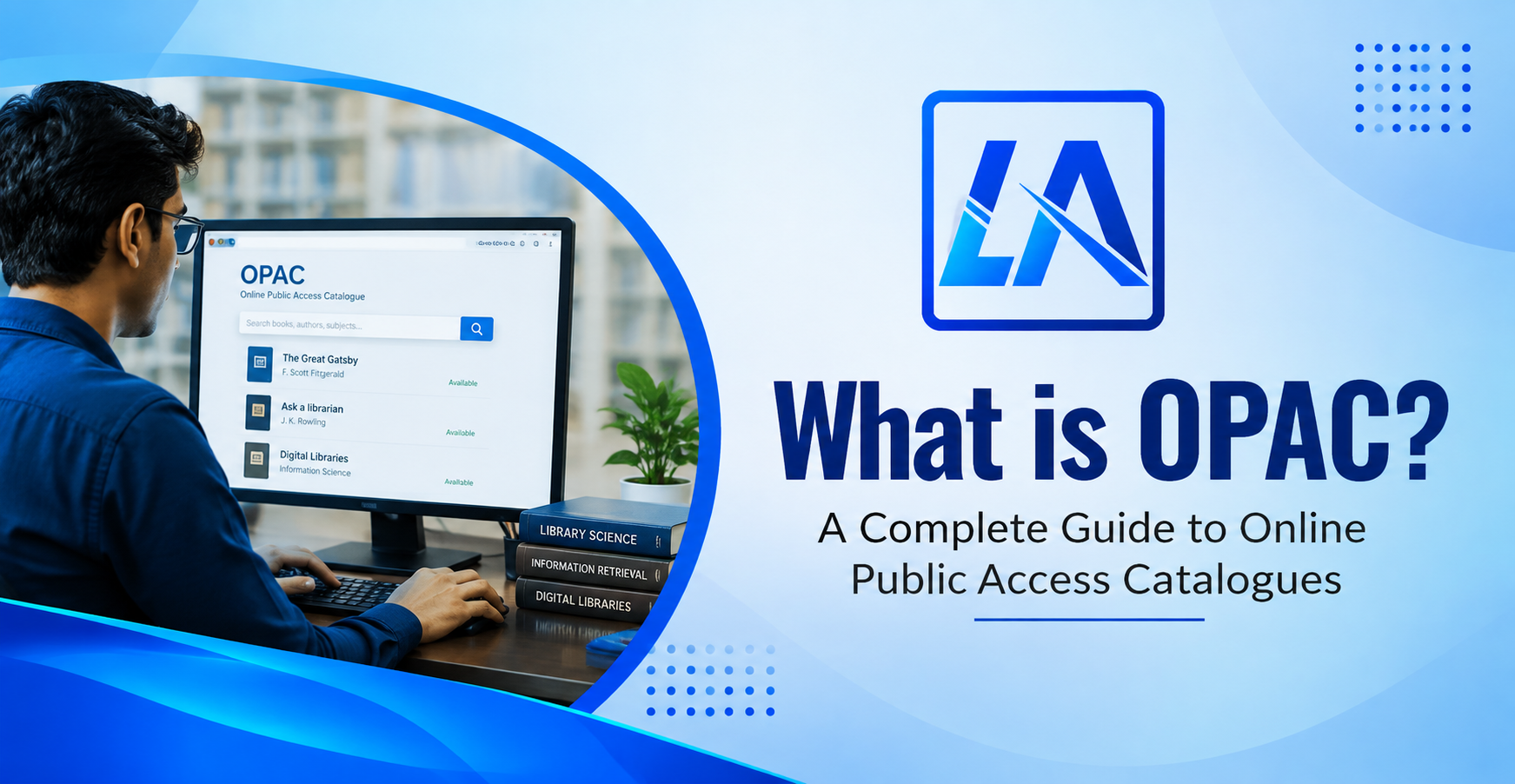
OPAC stands for Online Public Access Catalogue. It is a digital database of all resources available within a library system, including books, journals, research papers, thesis collections, and audio-visual materials.
In simple terms, OPAC acts as a specialized search engine for a library. It allows readers, students, and researchers to search the library’s collection electronically to check whether a specific item is available and pinpoint its exact physical location on the shelves.
Key Features of OPAC
- Multiple Search Fields:OPAC provides flexible search options. Users can search for resources using various parameters, such as:
- Author Name
- Title
- Subject / Subject Headings
- Keywords
- ISBN / Call Number
- Real-Time Status Updates:It offers live status tracking, informing the user whether a book is currently Available on the shelf, Checked out (Issued), or On Hold.
- Advanced Search & Boolean Operators:Users can refine their queries using Boolean logic (
AND,OR,NOT) alongside filters like publication year, language, and document type for precise search results. - 24/7 Accessibility via Web-OPAC:Modern institutions provide Web-OPAC, which extends the library catalogue to the internet, allowing users to access the database remotely from anywhere at any time.
Traditional Card Catalogue vs. OPAC
| Feature | Traditional Card Catalogue | OPAC (Online Catalogue) |
| Search Speed | Slow and manual | Instantaneous / High-speed |
| Accessibility | Limited to physical library premises | Accessible anywhere via Web-OPAC |
| Concurrent Access | Only one person can view a card drawer at a time | Multiple users can search simultaneously |
| Maintenance | High effort (manual filing and updating) | Automated updates via ILS software |
| Search Flexibility | Restricted to Author, Title, or Class Number | Highly flexible (Keywords, Publishers, Full-text, etc.) |
Key Benefits of OPAC
- Saves User Time: Eliminates the need to physically wander through library stacks to locate resources.
- Optimizes Library Operations: Streamlines circulation management, cataloguing, and inventory checking for library administrators.
- Remote Reservations & Renewals: Allows users to place holds, reserve books, or extend due dates online.
- Inter-Library Cooperation: Enables networked libraries to share catalogues, facilitating seamless resource sharing and Inter-Library Loans (ILL).
Conclusion
The implementation of OPAC marks a pivotal advancement in Library and Information Science (LIS). By bridging the gap between physical collection management and modern digital retrieval techniques, OPAC empowers users with instant access to information while establishing a foundation for futuristic digital library networks.
References & Citations
- Prytherch, R. (2016). Harrod’s Librarians’ Glossary and Reference Book (10th ed.). Routledge.
- Wynar, B. S., & Taylor, A. G. (2006). Introduction to Cataloging and Classification. Libraries Unlimited.
- American Library Association (ALA). Guidelines for OPAC Display and User Interfaces. ALA Standards & Guidelines.
- International Federation of Library Associations and Institutions (IFLA). Task Force on Guidelines for Operational Information in OPACs.