
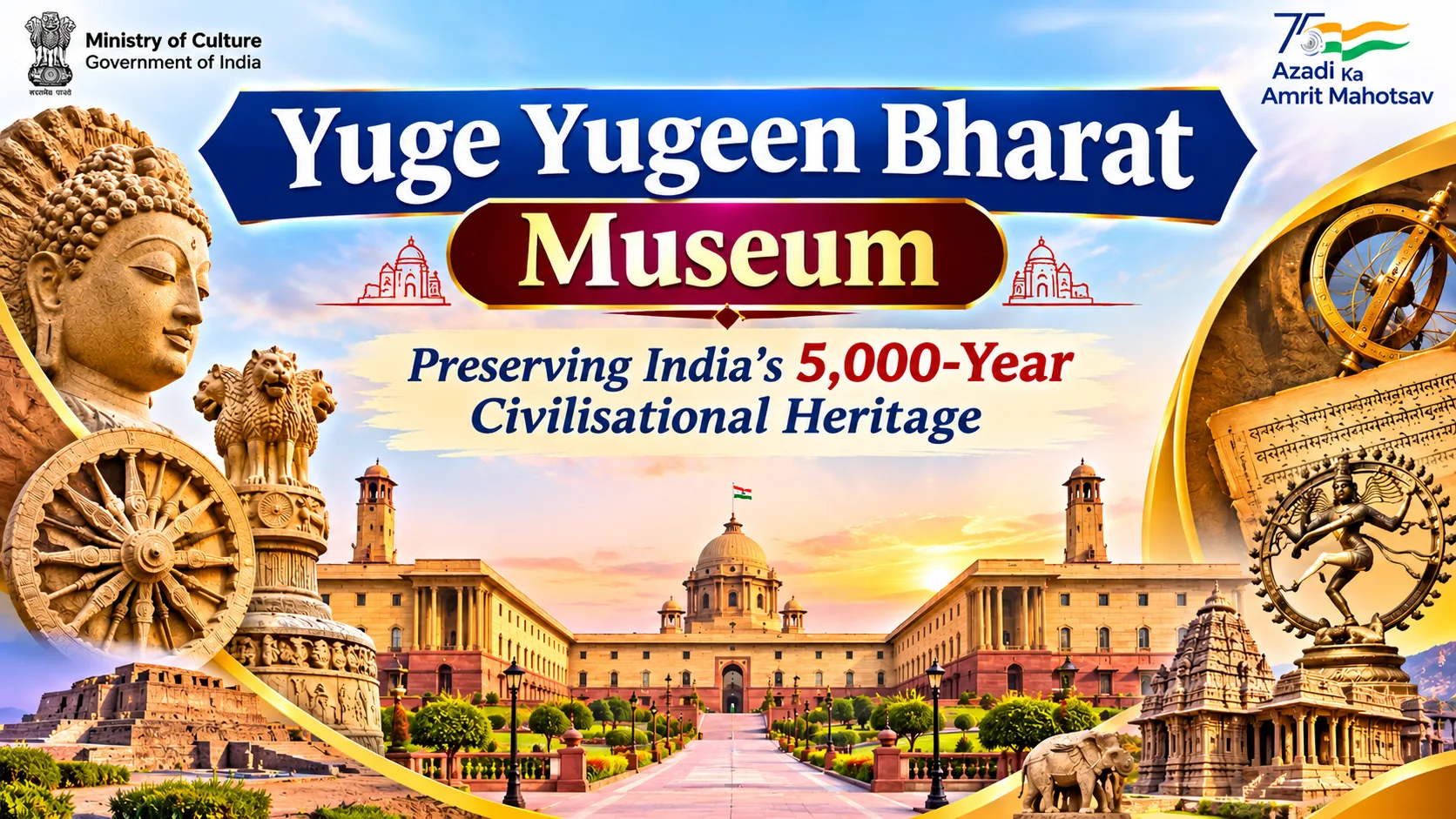
Yuge Yugeen Bharat Museum
Preserving India’s Civilisational Heritage for Future Generations
Exploring more than 5,000 years of India’s cultural, historical and intellectual journey.
India’s civilisation represents thousands of years of knowledge, art, architecture, science, traditions and cultural diversity. To preserve this remarkable legacy, the Government of India is developing the Yuge Yugeen Bharat Museum at the historic North and South Block Complex in New Delhi.
Announced by Prime Minister Narendra Modi on 18 May 2023, the project received Cabinet Committee on Economic Affairs (CCEA) approval on 11 November 2026. With an estimated cost of ₹3,230 crore, the museum aims to present India’s civilisational journey through historical collections, thematic galleries and modern technologies.
The museum will transform historic government buildings into public cultural spaces while preserving their architectural heritage through adaptive reuse.
1. Yuge Yugeen Bharat Museum: At a Glance
2. From Historic Buildings to a World-Class Museum
The North and South Blocks have been important centres of India’s governance. The South Block housed the Prime Minister’s Office after Independence, and Cabinet meetings under 16 Prime Ministers were held in these buildings.
Following the relocation of government offices to Seva Teerth and Kartavya Bhavans, these historic buildings are being transformed into public cultural spaces.
What is Adaptive Reuse?
Adaptive reuse means giving an existing building a new purpose while preserving its historical and architectural character.
- Preservation of historic façades and architecture.
- Conversion of courtyards, rooms and corridors into galleries.
- Modern visitor facilities with minimal intervention.
- Sustainable development and universal accessibility.
3. Museum Infrastructure and Visitor Capacity
| Particulars | Details |
|---|---|
| Built-up Area | 1,78,509 sq. metres |
| Display Area | More than 1 lakh sq. metres |
| Daily Visitor Capacity | 30,000 |
| Annual Visitor Capacity | 1 crore |
| Public Facilities | Children’s zones, food courts, souvenir shops and performance spaces |
The proposed display area is expected to exceed the approximate display areas of the Louvre Museum (73,000 sq. m), British Museum (70,000 sq. m) and Hermitage Museum (66,800 sq. m), as stated in the PIB Backgrounder.
4. Thematic Galleries: India’s Civilisational Journey
The museum will showcase India’s cultural and intellectual achievements through thematic galleries and immersive exhibitions.
5. First Gallery: Adornment Gallery
The Adornment Gallery is expected to become the first gallery open to the public in the North Block. Further galleries will be introduced progressively through a modular development approach.
6. Collection of 18 Lakh Heritage Objects
Approximately 18 lakh objects have been identified for potential display, reflecting India’s diverse historical and cultural traditions.
Major Sources of Collections
- National Museum.
- Other museums under the Ministry of Culture.
- 52 Archaeological Survey of India (ASI) site museums.
- Various State museums.
- Private collections.
Dedicated collection storage and conservation facilities are also planned to ensure the long-term preservation of these heritage objects.
7. Technology and Digital Experiences
Modern technologies will help visitors explore India’s history through interactive and immersive experiences.
| Technology | Purpose |
|---|---|
| AR | Augmented Reality-based interpretation |
| VR | Immersive virtual experiences |
| AI | Interactive interpretation and storytelling |
| Google Arts & Culture | Digital documentation of historic buildings and collections |
The Ministry of Culture’s collaboration with Google Arts & Culture was announced on 5 November 2026.
8. Employment, Tourism and Economic Opportunities
The project is expected to generate direct and indirect employment during construction and operational phases.
- Opportunities for artisans, craftspeople and performers.
- Employment for researchers, museologists and designers.
- Support for conservation professionals and technology providers.
- Promotion of Make in India through domestic manufacturing.
- Growth in cultural tourism, hospitality and visitor services.
Revenue is also expected from ticket sales, guided tours, food and beverages, events, retail outlets, digital experiences and venue rentals.
9. Implementation Timeline
| Milestone | Timeline |
|---|---|
| Project Announcement | 18 May 2023 |
| CCEA Approval | 11 November 2026 |
| Implementation Period | FY 2026–27 to FY 2030–31 |
| First Gallery – Adornment | Later part of 2027 |
10. Why is This Museum Important?
- Heritage Conservation: Preserving India’s tangible and intangible cultural heritage.
- Education and Research: Providing learning opportunities for students and scholars.
- Cultural Tourism: Promoting India as a global cultural destination.
- Employment: Creating opportunities in crafts, research, conservation and tourism.
- Global Recognition: Presenting India’s civilisational achievements internationally.
11. Important Facts for Competitive Exams
- Location: North and South Block Complex, New Delhi.
- Ministry: Ministry of Culture.
- Estimated Cost: ₹3,230 crore.
- Announcement: 18 May 2023.
- CCEA Approval: 11 November 2026.
- Objects Identified: Approximately 18 lakh.
- ASI Site Museums: 52.
- First Gallery: Adornment.
- Annual Visitor Capacity: 1 crore.
- Implementation: FY 2026–27 to FY 2030–31.
12. Frequently Asked Questions (FAQs)
North and South Block Complex, New Delhi.
₹3,230 crore.
Ministry of Culture.
18 May 2023.
Approximately 18 lakh.
13. Test Your Knowledge: 10 Important MCQs
Practice these questions for UPSC, SSC, BPSC, State PCS and other competitive examinations.
A. Mumbai
B. New Delhi
C. Kolkata
D. Jaipur
A. ₹2,500 crore
B. ₹4,000 crore
C. ₹3,230 crore
D. ₹5,000 crore
A. 15 August 2022
B. 18 May 2023
C. 26 January 2024
D. 2 October 2023
A. Ministry of Tourism
B. Ministry of Education
C. Ministry of Home Affairs
D. Ministry of Culture
A. 5 lakh
B. 10 lakh
C. 18 lakh
D. 25 lakh
A. Mathematics Gallery
B. Adornment Gallery
C. Astronomy Gallery
D. Architecture Gallery
A. 1,00,000 sq. m
B. 1,25,000 sq. m
C. 1,78,509 sq. m
D. 2,00,000 sq. m
A. 25
B. 40
C. 52
D. 75
A. 25 lakh
B. 50 lakh
C. 75 lakh
D. 1 crore
A. FY 2024–25 to FY 2027–28
B. FY 2025–26 to FY 2028–29
C. FY 2026–27 to FY 2030–31
D. FY 2027–28 to FY 2031–32
Conclusion
The Yuge Yugeen Bharat Museum represents an ambitious effort to preserve India’s civilisational heritage and make it accessible to future generations. By transforming historic government buildings into a modern cultural institution, the project brings together heritage conservation, education, technology and tourism.
For competitive examination aspirants, its project cost, location, thematic galleries, collection size and implementation timeline are important facts to remember.
Source: Press Information Bureau (PIB), Ministry of Culture, Government of India.
Read Official PIB Backgrounder
