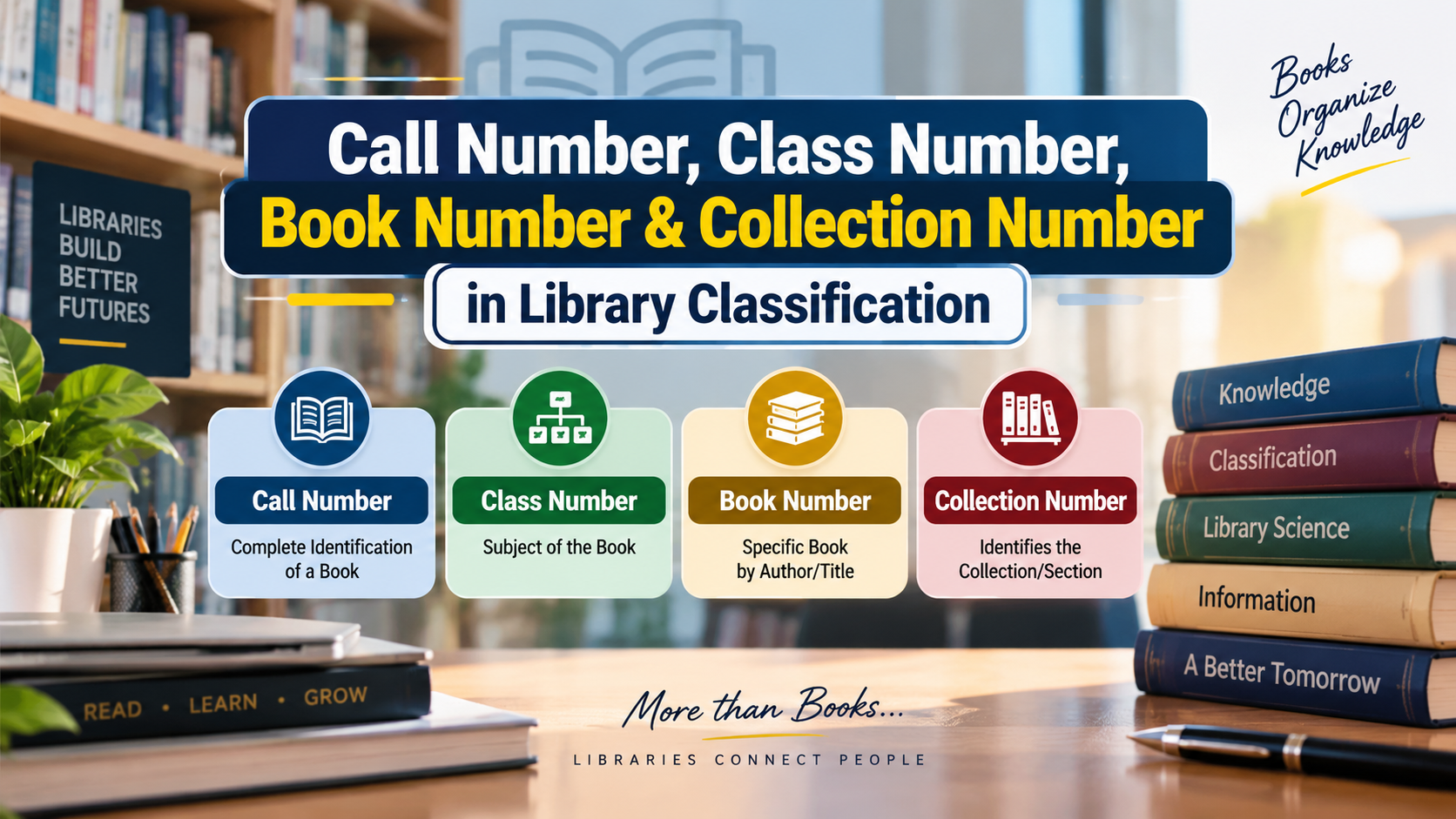
In a library, finding a particular book should not become a difficult task, especially when thousands of books are arranged on shelves. This is where library classification and call numbers become important.
A classification scheme brings books on the same or related subjects together. But simply knowing the subject of a book is not always enough to identify one particular copy. To locate an individual book, libraries use a call number, which acts like the book’s address on the shelf.
In this article, we will understand the meaning and difference between Call Number, Class Number, Book Number and Collection Number, along with simple examples from Colon Classification (CC) and Dewey Decimal Classification (DDC).
What is a Call Number?
A Call Number is a notation or combination of symbols assigned to a library item to identify and locate it within a particular library collection.
Think of it as the shelf address of a book. When you search for a book in a library catalogue, the call number helps you determine where that book has been placed.
The basic relationship can be expressed as:
Call Number = Class Number + Book Number + Collection Number
However, it is important to remember that the exact construction of a call number can vary according to the classification system and the local practices of a library.
The source material describes the call number as a means of identifying an individual book and helping the user locate its position in the collection.
Main Parts of a Call Number
A call number may contain:
- Class Number
- Book Number
- Collection Number
These three components perform different jobs.
1. What is a Class Number?
The Class Number represents the subject of a document.
A classification scheme divides knowledge into different subjects and assigns a notation—such as numbers, letters or a combination of symbols—to those subjects. That notation is called the class number.
For example, the same subject can have different class numbers in different classification schemes.
Example: Library Science
| Classification Scheme | Class Number for Library Science |
|---|---|
| Colon Classification (CC) | 2 |
| Dewey Decimal Classification (DDC) | 020 |
Similarly, the source gives:
| Subject | CC | DDC |
|---|---|---|
| Library Science | 2 | 020 |
| Mathematics | B | 510 |
Thus, the class number tells us what the book is about.
Easy way to remember
Class Number = Subject of the Book
For example:
DDC 020 → Library & Information Science
Here, 020 tells us the subject area; it does not by itself identify a particular book by a particular author.
2. What is a Book Number?
Suppose a library has 20 books on Library Science. All of them may have the same class number because they belong to the same subject.
For example:
020 = Library Science in DDC
If every Library Science book simply had the number 020, it would be difficult to arrange and distinguish individual books within that subject group.
This is where the Book Number becomes useful.
A book number helps distinguish books belonging to the same class and helps determine their relative arrangement.
According to the material based on Dr. S. R. Ranganathan’s explanation, the book number is a symbol used to fix the position of a book relative to other books belonging to the same ultimate class.
Easy way to remember
Class Number = Which subject?
Book Number = Which particular book within that subject?
Methods of Assigning Book Numbers
Different approaches can be used for constructing book numbers, depending on the classification system and the library’s practice.
One simple method mentioned in the source is the author’s surname method.
Under this method, letters from the author’s name are used to distinguish books.
For example:
| Author | Author Mark / Book Number |
|---|---|
| S. R. Ranganathan | RAN |
| Prof. Kasyap | KAS |
The source describes the use of the first three letters of the author’s surname/name as a simple method of creating a book number.
Suppose we have a book:
Author: Ranganathan
Subject: Library Science
A simple author-based book number may be:
RAN
The complete call number would then combine the subject notation and the book number, subject to the rules of the particular classification scheme and library.
Book Number in Colon Classification
One of the important contributions of Dr. S. R. Ranganathan was the development of a detailed approach to book numbers for Colon Classification.
The source gives the following Colon Book Number System formula:
[L][F][Y][A].[V]-[S];[C]:[Cr]
The symbols represent different characteristics of the book.
| Symbol | Meaning |
|---|---|
| L | Language of the book |
| F | Form of the book |
| Y | Year of publication |
| A | Accession part |
| V | Volume number |
| S | Supplement number |
| C | Copy number |
| Cr | Criticism number |
The source explains these components in detail.
Understanding the Formula
L – Language
Indicates the language in which the book is written.
F – Form
Indicates the form of the document, such as an index, list, picture or graph.
Y – Year
Indicates the year of publication.
A – Accession
This can distinguish books when multiple books on the same subject and from the same year are acquired.
V – Volume
Used where a publication consists of multiple volumes.
S – Supplement
Used for a supplement associated with a volume.
C – Copy
Useful when a library owns multiple copies of the same textbook or book.
Cr – Criticism
Used when the document deals with criticism of another work.
Simple Example of Colon Classification
Let us take a hypothetical example:
Book: Library and Information Science
Author: Ranganathan
Subject: Library Science
In Colon Classification, the class number for Library Science is 2.
If an author-based book number RAN is used for illustration, the basic combination can be represented as:
2 RAN
Here:
- 2 = Class Number representing Library Science
- RAN = Book Number/author mark identifying the book within the subject group
If a collection symbol is also required, it can be added according to the library’s local practice.
Note: This is an easy conceptual example for understanding the components. Actual Colon Classification numbers can be much more detailed because the final notation depends on the subject analysis and the book-number rules being applied.
Example of DDC Call Number
Now consider the same general subject using Dewey Decimal Classification (DDC).
For Library Science:
DDC Class Number = 020
Suppose a library uses an author mark such as RAN for a book written by Ranganathan.
An illustrative call number could therefore appear as:
020 RAN
Here:
- 020 → Class Number / subject notation for Library Science
- RAN → Author mark or book-number element used to distinguish the particular work
So, if the library has several books classified under 020, the author mark helps arrange or distinguish them.
Another example
Suppose two books are:
Book 1: Library Science — Ranganathan
Book 2: Library Science — Kumar
An illustrative arrangement might be:
020 RAN
020 KUM
The important idea is that both books belong to the same subject class, 020, but the additional element helps distinguish them.
Important: DDC itself primarily provides the classification number. The additional author/cutter information seen in a library call number is often determined by the library’s cataloguing and shelving practice. Therefore, call numbers can differ from one library to another.
Difference Between Class Number and Book Number
This is a very common examination question in Library and Information Science.
| Class Number | Book Number |
|---|---|
| Represents the subject | Distinguishes books within the same subject |
| Mainly answers “What subject?” | Helps answer “Which book?” |
| Assigned according to the classification scheme | Constructed according to the relevant book-number method/system |
| Books on the same subject may share it | Different books may have different book numbers |
| Example: 020 for Library Science in DDC | Example: RAN as an author mark |
The source similarly emphasizes that books belonging to the same class need an additional method of arrangement, and book numbers serve this purpose.
3. What is a Collection Number?
A Collection Number indicates the particular collection or major grouping to which a book belongs within a library or library system.
A library may not keep all its materials in one continuous sequence.
For example, a library may have separate:
- Reference Collection
- Textbook Collection
- Periodicals Collection
- Reading Room Collection
- Departmental Collections
- Rare Book Collection
- Children’s Collection
Therefore, merely knowing the subject and book number may not always tell us which collection contains the item.
The source explains that collection numbers can be used to indicate these major groupings and that libraries may create their own collection-number systems according to their requirements.
Examples of Collection Numbers
Some examples given in the source are:
| Collection / Location | Collection Number |
|---|---|
| Reading Room | RR |
| Periodicals Collection | PC |
| Library Science Department | 2D |
| Physics Department | CD |
These symbols are examples of how a library can identify different collections.
It is important to understand that collection numbers are often locally designed. Therefore, the same symbol does not necessarily have the same meaning in every library.
Complete Example: Understanding a Call Number
Let’s take a simple conceptual example:
Book: Library and Information Science
Author: Ranganathan
Classification: DDC
Collection: Reference
Suppose the library assigns:
- Class Number: 020
- Book/Author Number: RAN
- Collection Number: REF
The call number may be displayed conceptually as:
020 RAN REF
Now we can understand each part:
020 → Subject: Library Science
RAN → Identifies/distinguishes the particular author/work
REF → Indicates the Reference Collection
So the call number provides much more information than a simple subject number.
Call Number vs Class Number vs Book Number vs Collection Number
The easiest way to understand the difference is to think of a home address.
Imagine a large residential complex.
- Class Number = identifies the subject area/building
- Book Number = identifies the particular book within that subject
- Collection Number = identifies the special collection or section
- Call Number = the complete shelf/location identifier
Why is the Call Number Important in a Library?
A properly constructed call number makes the physical organization of a library much easier.
1. Helps locate books: A user can use the call number to find the physical location of a book on the shelf.
2. Keeps books on similar subjects together: Classification brings books dealing with related subjects into the same broad area.
3. Distinguishes individual books: The book-number element helps differentiate multiple books having the same class number.
4. Supports shelf arrangement: Call numbers provide an ordered sequence for arranging materials.
5. Helps library staff: Librarians can use call numbers for shelving, shelf reading, stock verification and collection management.
6. Useful in OPAC and library automation: In an automated library, the call number is generally recorded as part of the bibliographic/item information and can help users understand where an item is located.
Call Number and Shelf Location
A useful point for students is that a call number is not merely a classification number.
For example:
020
may identify the subject area of Library Science under DDC.
But:
020 RAN
provides additional information for distinguishing and arranging a particular work.
If a collection identifier is added:
020 RAN REF
the notation may also indicate that the item belongs to a particular collection.
Thus, the call number works as a practical bridge between bibliographic description, subject classification and physical arrangement.
Quick Revision Table
| Term | Simple Meaning | Example |
|---|---|---|
| Call Number | Complete identifier/location notation for a library item | 020 RAN REF |
| Class Number | Represents the subject | 020 |
| Book Number | Helps distinguish books within the same class | RAN |
| Collection Number | Identifies a collection/section | REF |
| CC Library Science | Class number in Colon Classification | 2 |
| DDC Library Science | Class number in DDC | 020 |
Frequently Asked Questions (FAQs)
What is a Call Number in Library Science?
A call number is a notation assigned to a library item to identify and locate it within the library collection.
What is a Class Number?
A class number is the notation representing the subject of a document in a classification scheme.
What is a Book Number?
A book number is used to distinguish and arrange individual books belonging to the same class or subject.
What is a Collection Number?
A collection number indicates the particular collection or major section in which a library item is located.
What is the Class Number of Library Science in Colon Classification?
The class number of Library Science in Colon Classification (CC) is 2.
What is the Class Number of Library Science in DDC?
The class number of Library Science in Dewey Decimal Classification (DDC) is 020.
Who developed the Colon Book Number System?
The detailed Colon Book Number System is associated with Dr. S. R. Ranganathan.
What is the formula of Colon Book Number?
The formula given in the source is:
[L][F][Y][A].[V]-[S];[C]:[Cr]
where L stands for Language, F for Form, Y for Year, A for Accession, V for Volume, S for Supplement, C for Copy and Cr for Criticism.
Conclusion
The concepts of Call Number, Class Number, Book Number and Collection Number are closely connected with the organization and retrieval of library materials.
The easiest way to remember them is:
Class Number → Subject
Book Number → Individual book/arrangement within the class
Collection Number → Collection or section
Call Number → Complete shelf/location identifier
For examination purposes, students should particularly remember the difference between class number and book number, the examples of CC and DDC, and Ranganathan’s Colon Book Number System.
Once these four concepts are understood together, many questions related to library classification, shelf arrangement and call numbers become much easier to solve.