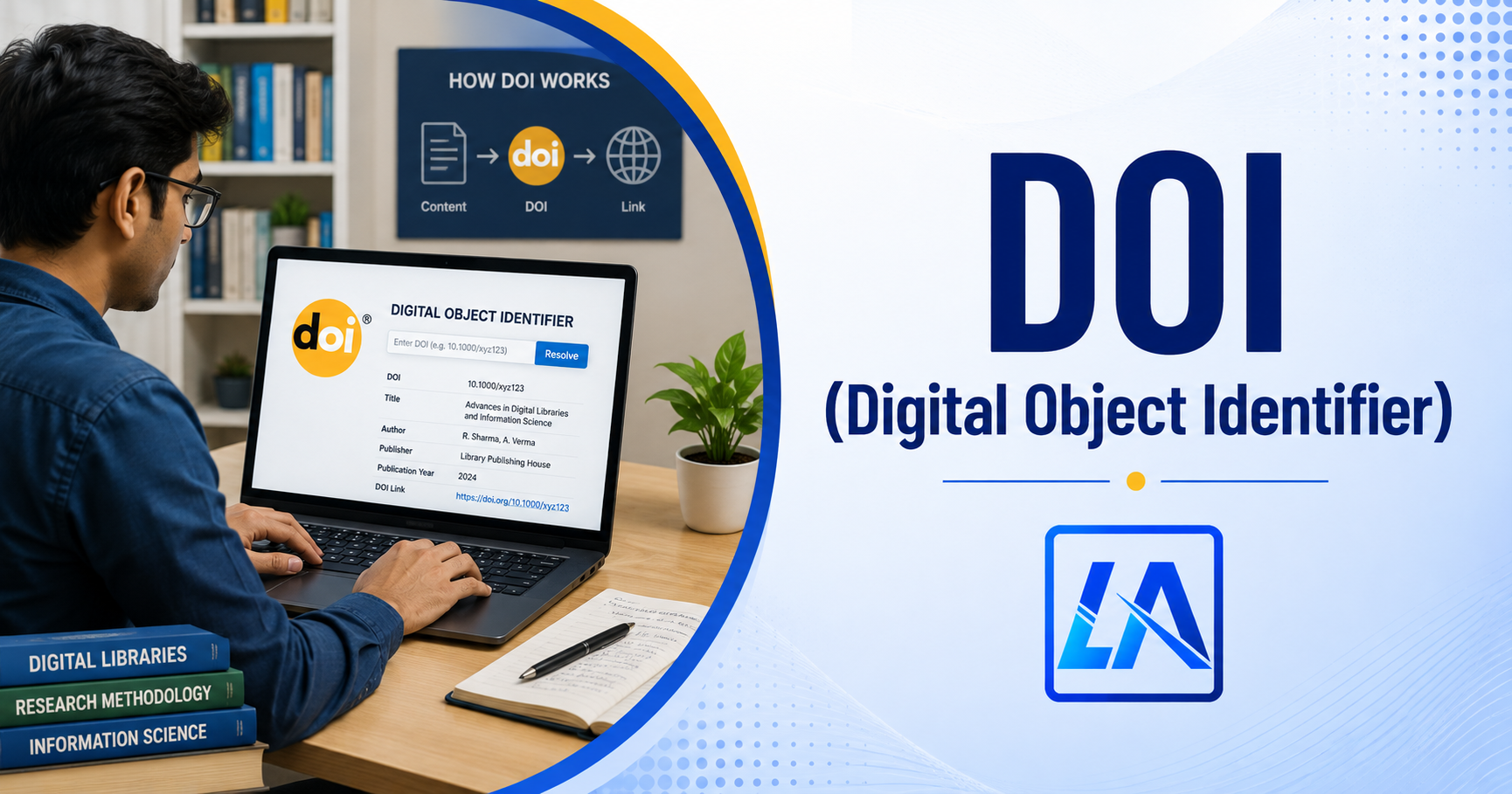
A DOI (Digital Object Identifier) is a unique, permanent alphanumeric string assigned to a digital document or object—most commonly scholarly journal articles, research papers, datasets, ebooks, and official reports.
Managed by the International DOI Foundation (IDF), a DOI serves as a permanent digital fingerprint for an online item.
Why is a DOI Important?
Unlike standard web URLs (web addresses) which can break or change when a website updates its structure—a phenomenon known as “link rot”—a DOI never changes.
- Permanent Redirection: Even if a publisher moves an article to a new server or domain, the DOI system automatically updates its records to point to the new location.
- Easy Citation: Standard citation styles (APA, MLA, Chicago, IEEE) require a DOI so readers can immediately locate the exact source material.
- Academic Integrity: It provides verifiable proof of publication and makes tracking scholarly impact (like citation counts) much easier.
Structure of a DOI
A typical DOI looks like this: 10.1016/j.lisr.2023.101234
It consists of two main parts separated by a forward slash (/):
  10.1016  /  j.lisr.2023.101234
 |_______|   |__________________|
  Prefix           Suffix
- Prefix (
10.xxxx):10.indicates the DOI directory.- The four-digit number following it identifies the registrant or publisher (e.g., Elsevier, Springer, Oxford University Press).
- Suffix:
- Created by the publisher to identify the specific document. It can include the journal name, publication year, volume, or internal tracking IDs.
When used as a web link, a DOI is prefixed with [https://doi.org/](https://doi.org/):
👉 [https://doi.org/10.1016/j.lisr.2023.101234](https://doi.org/10.1016/j.lisr.2023.101234)
Comparison: DOI vs. URL vs. ISBN
| Identifier | What It Identifies | Permanence | Example |
| DOI | Specific digital object (article, dataset, paper) | Permanent (never breaks) | 10.1000/182 |
| URL | Specific web page location | Temporary (subject to link rot) | [https://example.com/paper.pdf](https://example.com/paper.pdf) |
| ISBN | Entire book edition (print or electronic) | Permanent (for that edition) | 978-0-12-345678-9 |
Connection to Libraries and OPAC
In modern library cataloguing and Web-OPAC systems:
- Cataloguers embed DOIs into MARC21 records (Field
024). - Users clicking a DOI inside an OPAC search result are instantly routed to the full-text article on the publisher’s site or institutional repository, bypassing paywalls if the library holds an active subscription.
References (APA 7th Edition Format)
- International DOI Foundation. (2023). The DOI handbook. https://www.doi.org/doi_handbook/Table_of_Contents.html
- International Organization for Standardization. (2022). Information and documentation — Digital object identifier system (ISO Standard No. 26324:2022). https://www.iso.org/standard/81579.html
- Paskin, N. (2010). Digital Object Identifier (DOI®) System. In M. J. Bates & M. N. Maack (Eds.), Encyclopedia of Library and Information Sciences (3rd ed., pp. 1586–1592). CRC Press. https://doi.org/10.1081/E-ELIS3-120044407
- National Information Standards Organization. (2005). Syntax for the Digital Object Identifier (ANSI/NISO Z39.84-2005). NISO Press.