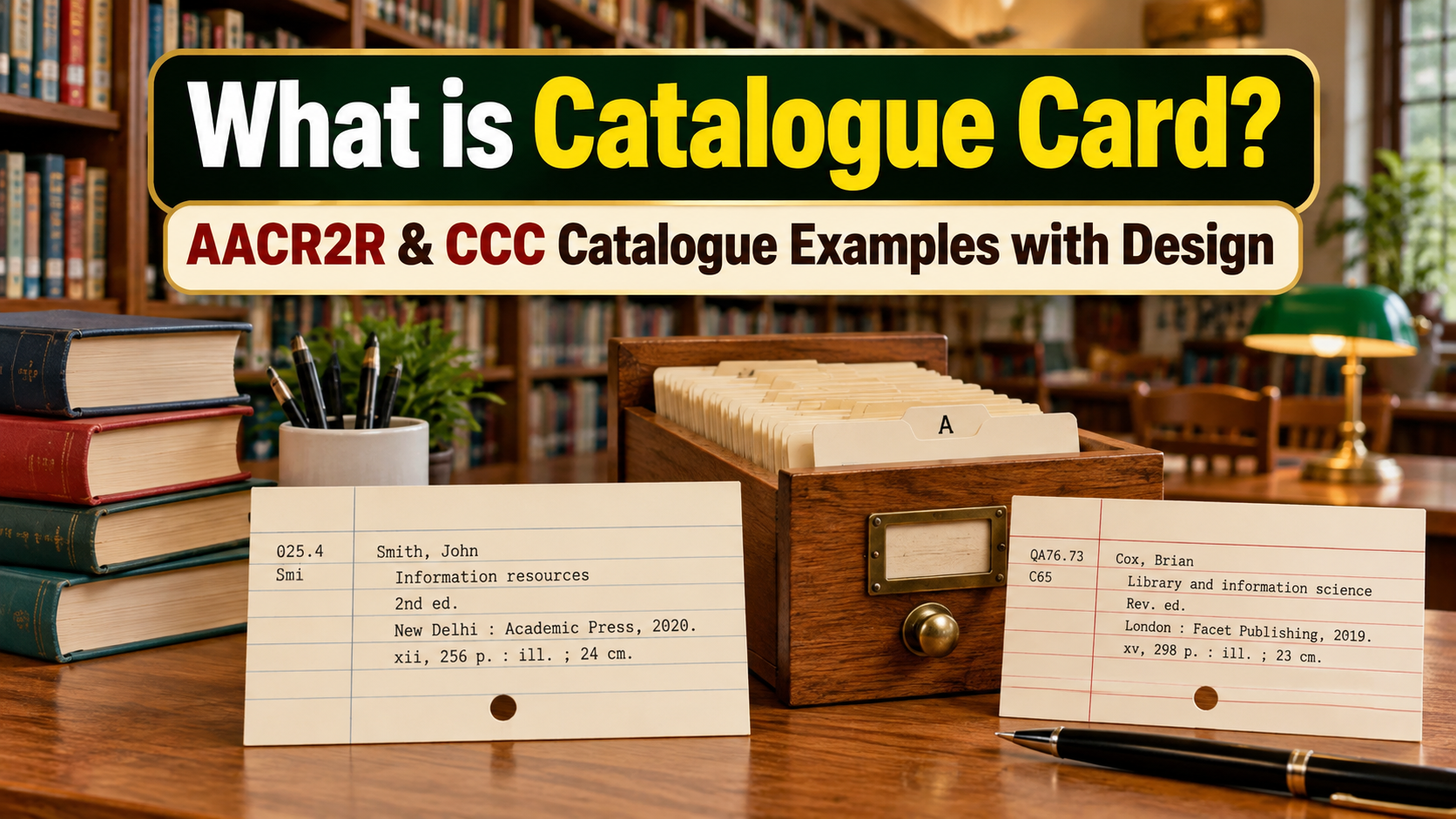
What is Catalogue Card? AACR2R and CCC Catalogue with Concept, Design & Examples
A catalogue card is a traditional method of representing the bibliographical details of a library document on a physical card. It tells the user important things about a book—such as its author, title, edition, publication details and subject—and provides an organized way to find that book in the library.
What is a Catalogue Card?
If you have ever seen an old library with rows of wooden drawers, there is a good chance those drawers contained hundreds or even thousands of small catalogue cards. Before libraries moved to computerized catalogues and OPACs, these cards were one of the main tools used for finding books.
But a catalogue card was not simply a piece of paper on which the librarian wrote the name of a book. There was a proper system behind it. The card contained selected bibliographical information and was arranged in such a way that a reader could approach the library collection through different access points.
For example, a reader might remember the author but forget the title. Another reader might know the title but not the author. Someone else might be looking for books on a particular subject. A well-organized catalogue was designed to support these different needs.
This is the basic idea behind the catalogue card: it creates an organized bridge between the reader and the library collection.
Why Was the Catalogue Card Needed?
Imagine a library containing 50,000 books. If the books were simply arranged on shelves without any systematic record, finding one particular book would be extremely difficult. The catalogue solved this problem by creating a separate record for each document.
The catalogue card provided the information needed to identify the document and, through appropriate access points, helped the user discover where the document belonged in the collection.
Therefore, the purpose of a catalogue is not merely to describe a book. It is also to help the user find, identify and select the required document.
What Information is Found on a Catalogue Card?
The exact arrangement depends on the cataloguing code and the type of entry, but a traditional catalogue card commonly contains information such as:
- Author or other heading
- Title and statement of responsibility
- Edition statement
- Place of publication
- Name of publisher
- Date of publication
- Physical description or pagination
- Illustration information
- Size of the book
- Series information, when applicable
- Notes
- Additional access points or tracing information
Basic Design of a Catalogue Card
One important thing to understand is that catalogue cards were not designed randomly. Different parts of the bibliographical description were placed in a particular order according to the cataloguing rules being followed.
For students, the easiest way to understand the design is to look at a simple example.
Ranganathan, S. R.
The five laws of library science / S. R. Ranganathan.
2nd ed. — New Delhi : ABC Publishers, 2015.
xx, 450 p. : ill. ; 24 cm.
Includes bibliographical references and index.
1. Library science. I. Title.
Now the card becomes much easier to read. The first line gives us the heading. We then move to the title, edition and publication information, followed by the physical description and notes.
This is why cataloguing is often described as a process of creating a structured bibliographical representation of a document.
Types of Catalogue Cards
Traditionally, the same book could be represented through more than one access point. This made the catalogue much more useful to readers.
Author Catalogue Card
Here, the author’s name acts as the main access point. If you know the writer of a book, you can use the author catalogue to find the relevant entry.
Title Catalogue Card
In a title entry, the title provides the access point. It is particularly useful when the reader remembers the name of the book but cannot remember who wrote it.
Subject Catalogue Card
A subject entry brings together documents dealing with a particular subject. For example, a student looking for material on Digital Libraries could approach the catalogue through the appropriate subject heading.
Added Entry
An added entry provides another access point to the same document. Depending on the work, this may relate to another author, editor, translator or another important access point.
What is AACR2R?
Now we come to one of the most important terms in traditional cataloguing: AACR2R.
AACR2R stands for Anglo-American Cataloguing Rules, Second Edition, 1988 Revision. It is a set of rules used for bibliographical description and for determining access points in library cataloguing.
The important point for students is to remember that AACR2R is not a catalogue card. AACR2R is the rule/code used by cataloguers, while the catalogue card is one possible physical form in which the resulting bibliographical record can be presented.
AACR2R = Cataloguing Rules
Catalogue Card = Physical form of a catalogue record
AACR2R Catalogue Card Example
Let us take a simple hypothetical example. Suppose a book has the following details:
- Author: R. K. Sharma
- Title: Library Management
- Edition: 3rd edition
- Place: New Delhi
- Publisher: ABC Publications
- Year: 2022
- Pages: 350
A simplified educational representation of the catalogue record could look like this:
Sharma, R. K.
Library management / R. K. Sharma.
3rd ed. — New Delhi : ABC Publications, 2022.
xv, 350 p. ; 24 cm.
1. Library management. I. Title.
Notice how the information is presented in a logical sequence. The author’s name provides the heading, followed by the title and statement of responsibility, edition, publication details and physical description.
What is CCC in Library Science?
Another name that every Library and Information Science student encounters while studying cataloguing is CCC.
CCC stands for Classified Catalogue Code. It was developed by Dr. S. R. Ranganathan, one of the most influential figures in Library and Information Science.
The idea behind CCC is closely connected with the concept of the classified catalogue. Ranganathan’s approach gives an important place to classification and systematic arrangement while providing access to library documents.
For an LIS student, CCC is particularly significant because it is not just another list of cataloguing rules. It reflects Ranganathan’s broader thinking about how a library catalogue should organize information and serve the reader.
CCC Catalogue Example
Suppose we have a hypothetical book written by R. K. Sharma with the title Library Management. A simplified example for understanding the basic idea may be represented as follows:
Sharma, R. K.
Library management / R. K. Sharma.
New Delhi : ABC Publications, 2022.
xii, 320 p. : ill. ; 24 cm.
Library management — Classified arrangement.
The CCC example above is intentionally simplified for teaching and conceptual understanding. Actual catalogue entries should be prepared by following the relevant provisions of the particular edition of the cataloguing code and the nature of the document.
AACR2R and CCC: What is the Difference?
Students often confuse AACR2R and CCC because both are associated with cataloguing. The easiest way to separate them is to look at their origin and approach.
| AACR2R | CCC |
|---|---|
| Anglo-American Cataloguing Rules, Second Edition, 1988 Revision | Classified Catalogue Code |
| Associated with Anglo-American cataloguing practice | Developed by S. R. Ranganathan |
| Provides rules for bibliographical description and access points | Closely associated with classified catalogue practice |
| Used as a cataloguing code | An important Indian contribution to cataloguing theory and practice |
Catalogue Card and OPAC: From Drawers to Computers
The card catalogue may look old-fashioned today, but it is important to understand what problem it was solving. Its basic objective was to provide organized access to the library collection.
Modern libraries usually perform the same basic function through an OPAC (Online Public Access Catalogue). Instead of opening drawers and physically going through cards, users can search a digital catalogue using a computer or other device.
The technology has changed dramatically, but the fundamental idea remains: connect the user with the information resources of the library.
Why Should LIS Students Study Catalogue Cards?
A natural question is: if modern libraries use OPACs, why should a student still study catalogue cards?
The answer is simple. Understanding traditional cataloguing makes it much easier to understand how bibliographical records evolved. Concepts such as heading, entry, access point, description, added entry and subject access did not disappear when libraries became computerized. They became part of the foundation on which modern library catalogues were developed.
For students preparing for BLIS, MLIS, UGC NET Library Science, KVS, NVS and other LIS examinations, these concepts are therefore both academically important and useful from an examination perspective.
- AACR2R: Anglo-American Cataloguing Rules, Second Edition, 1988 Revision.
- CCC: Classified Catalogue Code.
- CCC Developer: S. R. Ranganathan.
- Catalogue Card: Traditional physical representation of a bibliographical record.
- Common Access Points: Author, Title and Subject.
- OPAC: Online Public Access Catalogue.
Conclusion
A catalogue card may belong to the traditional era of librarianship, but the idea behind it remains fundamental to Library and Information Science. It provided a systematic way of representing documents and gave readers different routes through which they could discover the resources available in a library.
AACR2R and CCC represent two important cataloguing traditions that every LIS student should understand. AACR2R provides standardized rules for bibliographical description and access, while Ranganathan’s Classified Catalogue Code represents an important approach to classified cataloguing.
Once the relationship between document → bibliographical record → catalogue entry → access point → user is understood, the entire concept of catalogue cards becomes much easier to remember.
Frequently Asked Questions
A catalogue card is a traditional physical record containing the bibliographical information of a library document and providing access to that document through appropriate entries.
AACR2R stands for Anglo-American Cataloguing Rules, Second Edition, 1988 Revision.
CCC stands for Classified Catalogue Code, developed by S. R. Ranganathan.
No. AACR2R is a cataloguing code, whereas a catalogue card is a physical form used to represent a bibliographical record.
Traditional catalogues commonly provided author, title, subject and added entries as different access points to library documents.